Rubbing compound uses coarse abrasives to level heavy paint defects, deep scratches, and severe oxidation. Polishing compound uses finer particles to remove light swirls, restore gloss, and refine the finish. Use rubbing compound first for neglected surfaces, then follow with polishing compound to bring back clarity and shine.
Over the past decade of detailing daily drivers and project cars, I have reached for both rubbing compounds and polishing compounds across dozens of paint correction jobs. Choosing the wrong bottle can either waste your physical effort on stubborn scratches or scuff your clear coat into a hazy mess. In this guide, I will break down how their abrasives behave, how they cut, and which option matches the exact condition of your vehicle.
Rubbing Compound vs Polishing Compound: At a Glance
Rubbing Compound
|
Polishing Compound
|
|
|---|---|---|
| Abrasive Aggressiveness | Coarse, gritty abrasives engineered for deep leveling and severe defect removal. | Fine, gentle abrasives designed to smooth minor flaws and micro-marring. |
| Primary Function | Eradicates heavy scratches, severe oxidation, etchings, and dead paint layers. | Restores optical clarity, depth, and reflective shine to the clear coat. |
| Resulting Surface Finish | Leaves a dull, hazy, or matte surface requiring further refinement. | Leaves a glossy, slick, and mirror-like finish ready for protection. |
| Clear Coat Removal | Removes a noticeable amount of clear coat; higher risk of strike-through. | Removes minimal clear coat material, preserving paint thickness. |
| Process Stage | First-step correction on heavily neglected, weathered, or scratched finishes. | Intermediate or final refinement step following compounding, or standalone light correction. |
| User Friendliness | Requires careful technique to avoid burn-through, holograms, or severe scouring. | Forgiving and easy to handle for both beginners and experienced detailers. |
| Follow-Up Requirement | Mandatory secondary step with polishing compound to eliminate haze. | Directly ready for final surface protection like wax, sealant, or ceramic coating. |
Complete Comparison: Rubbing Compound vs Polishing Compound
| Turtle Wax T230A 10.5 Oz Rubbing | Meguiar’s Ultimate Compound, Pro-Grade Car Scratch | |
|---|---|---|
| Product Image | |
|
| Price | View On Amazon | View On Amazon |
| Category | Budget Heavy-Duty Compound | Mid-Range Paint Correction Compound |
| Container Size | 10.5 Oz | 15.2 Oz |
| Abrasive Technology | Heavy-duty coarse abrasives | Exclusive micro-abrasive technology |
| Heavy Defect Removal | Deep scratches, heavy oxidation, tough stains & road grime | Moderate-to-deep scratches, swirls, oxidation & water spots |
| Finish Quality & Hazing | High-cut abrasive finish (typically requires fine polish) | Restores clarity and showroom shine without hazing |
| Paint Compatibility | Clear coats, single-stage, and lacquers | Clear coats and all glossy automotive paints |
| Application Versatility | Hand application or rotary/machine buffer | Hand application or Dual-Action (DA) polisher |
| Best For | Heavily neglected paint, deep oxidation, and aggressive spot compounding | One-step paint correction, swirl removal, and scratch repair with high gloss |
| Amazon Link | View On Amazon | View On Amazon |
| Overall Winner | Runner-up | Winner |
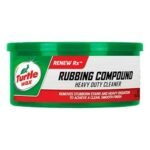
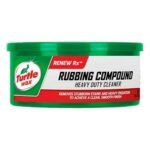
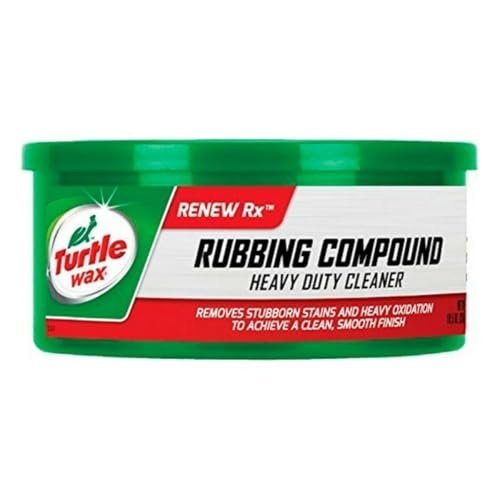
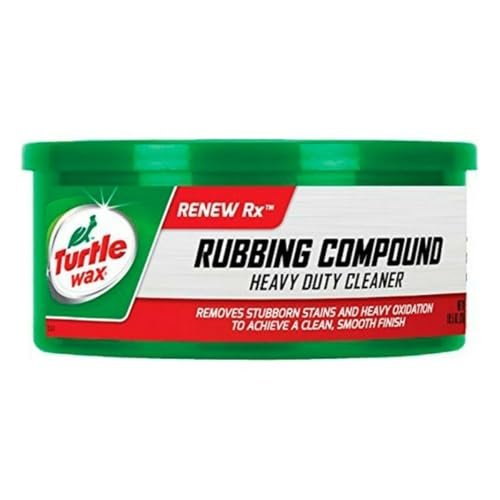
Turtle Wax T230A Rubbing Compound Heavy Duty Cleaner
I keep Turtle Wax T230A in my garage for cases where paint looks practically dead. Its heavy-duty cleaning power relies on coarse, gritty abrasives designed to grind through stubborn road film, deep stains, and crusty surface contaminants. The paste cuts fast into neglected clear coats and single-stage enamel finishes. Because of that aggressive grit, the advanced formula prioritizes pure cutting speed over fine gloss, leaving behind a matte haze you must polish out later. Working this versatile application by hand or dual-action buffer gives predictable results on hard paints, provided you monitor your working pressure closely. It remains an easy to use staple for removing serious gouges before beginning any finishing work.
- Heavy-duty cleaning power that cuts away heavy oxidation, transfer marks, and severe scratches
- Advanced formula utilizing coarse abrasives engineered for aggressive paint leveling
- Versatile application compatible with hand pads, rotary buffers, and dual-action polishers
-
Broad finish compatibility across modern clear coats, vintage lacquers, and single-stage paint
-
Cuts deep defects much faster than light polishes
- Inexpensive and widely available for spot repairs
-
Levels weathered single-stage paints quickly
-
Leaves a dull, hazy finish that requires a second polishing step
- High risk of thinning clear coat if worked aggressively on edges
Best for: Drivers tackling heavy oxidation, deep branch scratches, or paint transfer on older or neglected finishes.
Expert Opinion: Use this as a corrective chisel rather than a finishing tool, and always follow up with a finer polish to restore clarity.
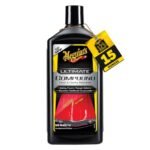
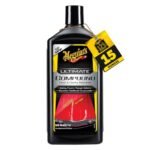
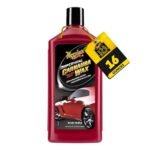
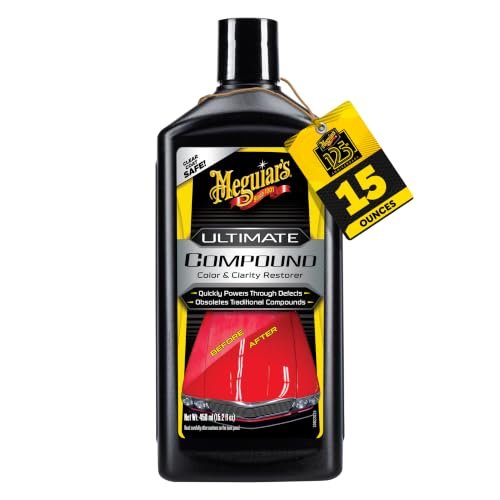
Meguiar’s Ultimate Compound
Meguiar’s Ultimate Compound behaves differently than traditional gritty pastes because it balances cut and clarity. The formula uses exclusive micro-abrasive technology that shears paint defects down without gouging the clear coat. In my garage, this product works as a modern polishing compound hybrid, delivering showroom shine right alongside reliable defect correction. It safely removes swirls, water etching, and light fading while preserving gloss. Detailers will appreciate that it is completely clear coat safe, generating minimal dusting whether running a dual-action polisher or scrubbing a door cup by hand. You get a fast and flawless transition from a defect-ridden surface to clean gloss in a single pass.
- Exclusive micro-abrasive technology cuts defects evenly while refining the surface finish
- Showroom shine capabilities that leave deep gloss without micro-marring
- Clear coat safe composition engineered to prevent surface scouring on modern paint
-
Fast and flawless defect removal for swirl marks, bird drop etching, and water spots
-
Leaves a glossy, haze-free finish on most clear coats
- Very forgiving for beginners using hand pads
-
Cleans off easily with minimal dry powder residue
-
Takes longer to level severe, deep gouges than a dedicated heavy rubbing paste
- Higher cost per fluid ounce compared to basic heavy cleaners
Best for: Anyone wanting to remove moderate swirls, light scratches, and oxidation while leaving a high-gloss finish in one stage.
Expert Opinion: This is the most versatile compound on the market for weekend detailers because it rarely requires a secondary polishing step to look decent.
Rubbing Compound vs Polishing Compound: Key Differences That Matter
Performance Comparison
Rubbing compound acts like liquid sandpaper. It strips away a measurable layer of clear coat to flatten out gouges, stubborn paint transfer, and calcified water spots. When I used Turtle Wax T230A on an oxidized truck hood, it eradicated chalky white fade in three passes. The surface was level, yet the finish appeared dull and milky.
Polishing compounds step in where heavy cleaners leave off. Meguiar’s Ultimate Compound uses diminishing micro-abrasives that round off scratch edges instead of hacking away clear coat. When run over that same hazy truck hood, the finer particles burnished the surface back to a reflective mirror. If your paint suffers from light car wash swirls or faint towel marks, a rubbing compound is overkill, while a polishing compound is spot on.
Price and Value Analysis
Traditional rubbing compounds run cheaper at the auto parts store. You can grab a tub of Turtle Wax paste for just a few dollars, making it a great budget buy for fixing an isolated bumper scuff. The hidden cost lies in the extra steps. Because a heavy compound ruins surface gloss, you are forced to buy a separate polish and finishing pad to complete the job properly.
Polishing compounds cost more upfront per ounce. Even so, bottles like Meguiar’s Ultimate Compound often save you money overall. They perform double duty by leveling light defects and refining gloss in one step, sparing you from purchasing two separate chemicals and pad sets.
Build Quality and Abrasive Composition
The main mechanical difference comes down to abrasive shape, hardness, and carrier liquid. Heavy rubbing compounds utilize large, sharp aluminum oxide or silica particles suspended in thick carrier pastes. These particles remain coarse throughout your working cycle. They do not break down easily, which makes them cut aggressively from the moment your pad touches the paint until you wipe the residue off.
Modern polishing compounds rely on engineered micro-abrasives or diminishing abrasives suspended in slick lubricating emulsions. As you work the product across the panel, the friction breaks these particles down into microscopic fragments. You start with light cutting power and end with pure jeweling polish. This abrasive breakdown protects thin modern factory clear coats from premature clear coat failure.
User Experience Differences
Working with an old-school rubbing paste requires careful muscle control. Turtle Wax T230A grabs the pad quickly, creates significant friction, and dries fast into a powdery white paste. You must tape off plastic trim, watch body body lines, and wipe the panel before the residue bakes on.
Polishing compounds provide a noticeably smoother work cycle. Meguiar’s formula spreads easily, stays wet on the panel longer, and buffs off with a soft microfiber towel using very little elbow grease. For beginners running a dual-action polisher for the first time, polishing compounds offer a much wider margin of safety against burning through the paint.
Which Should You Choose?
The depth of your paint defects and your willingness to run a multi-step process will determine which bottle belongs on your workbench.
| Choose Turtle Wax Rubbing Compound if… | Choose Meguiar's Ultimate Compound if… |
|---|---|
| Removing severe oxidation on older single-stage paint | Eliminating spiderweb swirls from automatic car washes |
| Clearing away heavy paint transfer after a parking scrape | Restoring gloss and depth to hazy clear coats safely |
| Eliminating deep scratches that catch your fingernail slightly | Correcting paint in a single step without leaving micro-haze |
| Prepping severely weathered panels before wet sanding and repainting | Working by hand or machine without risking clear coat strike-through |
Frequently Asked Questions
Q: When comparing Rubbing Compound vs Polishing Compound, what is the main difference in grit?
A: Rubbing compound contains coarse, aggressive abrasives meant to plane down heavy scratches and severe oxidation quickly. Polishing compound contains much finer, microscopic abrasives designed to refine the paint surface, eliminate micro-marring, and bring out deep gloss.
Q: Can I use Rubbing Compound vs Polishing Compound together on the same car?
A: Yes, using them in sequence is standard practice for heavily weathered vehicles. Apply the rubbing compound first to level severe scratches, wipe off the residue, and follow up with the polishing compound to remove the dull haze left behind by the heavy grit.
Q: Will rubbing compound damage my clear coat?
A: It can easily cause damage if used too aggressively or too often. Because rubbing compound removes a noticeable layer of clear coat, pressing down hard by hand or running high machine speeds can cut through the clear layer down to the base color, especially around sharp body lines.
Q: Do I need a machine polisher to apply these compounds?
A: Both compounds can be applied by hand using a microfiber applicator pad or foam block. Using a dual-action orbital machine will save substantial physical effort and yield a much more uniform finish across large panels like hoods and roofs.
Q: Can polishing compound remove deep scratches?
A: No, polishing compound is strictly engineered for light swirls, towel marks, and faint water etching. If a scratch is deep enough to catch your fingernail as you slide it across the paint, polishing compound will round the edges slightly but will not remove it completely.
Q: Should I apply wax directly after using a rubbing compound?
A: You should avoid applying wax directly after a rubbing compound because the surface will remain hazy and rough. Run a fine polishing compound over the panel first to restore true optical clarity, wipe the area clean, and then seal the paint with wax or ceramic sealant.
Q: How often can I safely use rubbing compound on my car paint?
A: You should only use rubbing compound when absolutely necessary to fix severe damage. Modern factory clear coats are thinner than a post-it note, so running a heavy compound more than once or twice over the lifespan of a vehicle risks burning through the protective topcoat.
When you purchase a product through Amazon links on carsolutionpro.com, we may earn a small commission at no extra cost to you. This helps support the site and keep our content free. As an Amazon Associate, we earn from qualifying purchases made through our links.