A single channel dash cam records forward road traffic, while a dual channel system records both front and rear views simultaneously. Choose a single channel camera if you want an inexpensive, simple setup for daily commutes. Opt for a dual channel camera if you need complete accident liability protection and parking monitoring from behind.
I have spent years mounting, rewiring, and evaluating dash cameras across different vehicles to see how they perform when something unexpected happens. In this guide, I share my hands-on findings testing front-only coverage alongside front-and-rear systems in real traffic. You will learn how these camera types handle installation, nighttime lighting, memory usage, and parking defense so you can pick the right setup for your vehicle.
Single Channel Dash Cam vs Dual Channel Dash Cam: At a Glance
Single Channel Dash Cam
|
Dual Channel Dash Cam
|
|
|---|---|---|
| Coverage Scope | Captures the road ahead from the front windshield only. | Captures simultaneous synchronized video from both front and rear windshields. |
| Installation Complexity | Quick, simple setup requiring basic cable routing along the front windshield. | More involved installation requiring wire routing through the cabin to the rear. |
| Memory Card Consumption | Consumes less storage, enabling longer recording retention on smaller memory cards. | Fills storage twice as fast by recording two concurrent video streams. |
| Rear-End Incident Context | Provides indirect evidence inferred from forward motion or sudden vehicle jolts. | Delivers direct visual proof of tailgating, rear impacts, and hit-and-run drivers. |
| Parking Mode Protection | Detects impacts or motion occurring only in front of the vehicle. | Provides dual-angle coverage, recording activity at both ends of parked vehicles. |
| Power Consumption | Draws minimal power, reducing strain on the vehicle battery during parking. | Higher power draw required to process and encode two camera feeds simultaneously. |
| Vehicle Interior Footprint | Discreet, minimalist profile confined solely behind the rearview mirror. | Requires secondary camera mounting and visible cable management along the rear window. |
Complete Comparison: Single Channel Dash Cam vs Dual Channel Dash Cam
| galphi 4K Dash Cam Front, 5GHz | VIOFO A229 Plus Dash Cam Front | |
|---|---|---|
| Product Image | |
|
| Price | View On Amazon | View On Amazon |
| Category | Budget Front-Only | Premium Dual-Channel |
| Channel Coverage | Single Channel (Front Only) | Dual Channel (Front & Rear) |
| Video Resolution | 4K UHD 2160P (Front) | 2K 1440P Front + 2K 1440P Rear (Up to 60fps Front) |
| Image Sensor & HDR | F/1.6 Aperture with WDR | Dual Sony STARVIS 2 IMX675 with Dual-Channel HDR |
| Field of View | 160° Wide Angle | Front & Rear Wide Angle Coverage |
| Display Design | Screen-Free Minimalist Design | Integrated Screen with Upgraded Menu UI |
| Included Storage | 32GB MicroSD Card Included (Pre-installed) | None Included (Supports up to 512GB) |
| Wi-Fi & App Connectivity | 5GHz Wi-Fi (Up to 8MB/s) with Free App | 5GHz Wi-Fi with VIOFO App Control |
| GPS Logging | Not Supported | Quad-Mode GPS (GPS, BEIDOU, GALILEO, GLONASS) |
| Voice Control | Not Supported | Smart Hands-Free Voice Control (12 Commands) & Voice Notifications |
| Parking Mode Capabilities | 24H Time-Lapse Mode (Hardwire Kit Required, Not Included) | 3 Parking Modes: Buffered Auto Event Detection, Time Lapse, Low Bitrate (HK4 Required) |
| Power Supply / Protection | Standard Internal Battery / Circuit Protection | Built-in Supercapacitor |
| Best For | Drivers seeking an affordable, discreet, screen-free front camera ready out of the box | Drivers demanding premium front & rear coverage with elite night vision, HDR, and GPS logging |
| Amazon Link | View On Amazon | View On Amazon |
| Overall Winner | Runner-up | Winner |
Galphi 4K Dash Cam (Single Channel) Review
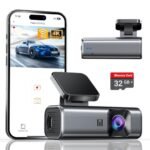
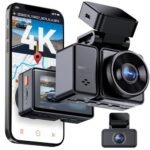
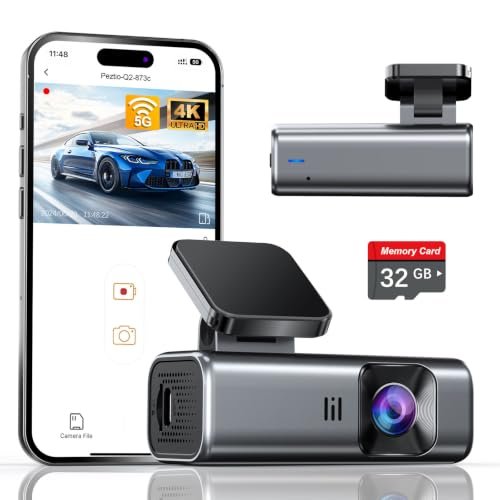
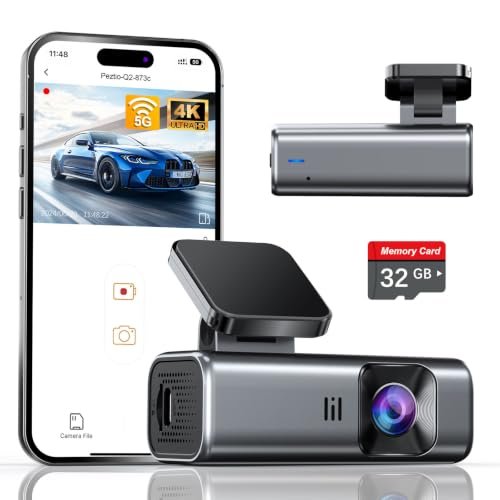
I mounted the Galphi 4K on my windshield right behind the rearview mirror to test how well a minimalist forward camera handles daily commutes. This camera captures your forward drive in crisp 4K 2160P resolution, producing readable signs and crisp vehicle outlines during bright afternoons. Because of its discreet screen-free design, you never have to deal with an illuminated monitor reflecting off the glass during nighttime drives. Grabbing clips from the camera took seconds through the 5GHz Wi-Fi connection and mobile app on my phone. Its 160-degree wide angle lens spans multiple lanes of highway traffic easily, and Galphi saves you an errand by providing an included 32GB memory card right in the box.
Key Features
- 4K 2160P front recording with an ultra-wide 160-degree viewing angle
- 5GHz Wi-Fi connectivity paired with smartphone app playback
- Screen-free compact housing that hides behind your rearview mirror
- G-sensor incident detection and loop recording capability
- Included 32GB memory card for immediate use out of the box
Pros
- Discreet footprint keeps your windshield clutter-free
- Rapid clip transfers over high-speed 5GHz Wi-Fi
- Ready to run immediately thanks to the packaged memory card
- Clear forward daylight footage for reading signs
Cons
- Leaves your vehicle blind to rear impacts and tailgaters
- Adjusting menu options requires opening the smartphone app
- Night performance degrades significantly on dark, unlit roads
Best for: Budget-focused drivers, rideshare workers wanting basic forward coverage, and anyone who wants a five-minute installation without tucking wires across the entire cabin.
Expert Opinion: The Galphi 4K shows how clean and effective a single-lens setup can be, giving you sharp forward documentation while keeping your dashboard completely free of clutter.
VIOFO A229 Plus (Dual Channel) Review
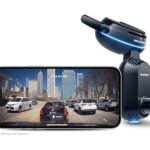
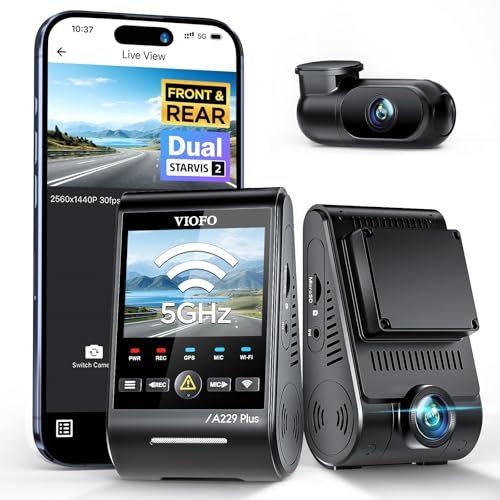
Running the VIOFO A229 Plus gave me complete peace of mind because it watches the road ahead and the bumper behind simultaneously. Both camera units rely on Dual Sony STARVIS 2 IMX675 sensors, delivering balanced 1440P + 1440P dual-channel recording without heavy digital noise. High-contrast situations like sun glare or blinding high beams are stabilized by front and rear Dual-Channel HDR technology, making license plates readable in tricky lighting. I loved using the smart voice control to save unexpected road events without ever pulling my hands away from the steering wheel. Route tracking is covered by an ultra-precise quad-mode GPS module, while a heat-resistant built-in supercapacitor protects your recordings from summer cabin heat waves.
Key Features
- Dual Sony STARVIS 2 IMX675 sensors for front and rear clarity
- Dual-channel 2K 1440P HDR recording with up to 60fps on the front lens
- Hands-free voice control featuring 12 useful spoken triggers
- Quad-mode GPS receiver logging speed, route coordinates, and time
- Built-in supercapacitor built for extreme summer and winter climates
Pros
- Outstanding low-light clarity and rear plate capture
- Complete protection against rear-end collisions and tailgater disputes
- Supercapacitor prevents battery swelling in hot weather
- Voice commands allow fast clip locking while keeping both hands on the wheel
Cons
- Routing the long rear cable through roof liners demands time and patience
- Substantially higher price point than basic single-lens cameras
- Front unit takes up slightly more windshield space
Best for: Commuters facing heavy stop-and-go traffic, drivers wanting full liability proof for rear-end collisions, and vehicle owners who leave their cars parked on busy city streets.
Expert Opinion: Thanks to matched STARVIS 2 sensors, the VIOFO A229 Plus sets the standard for balanced two-channel capture, producing readable rear plates where older sensors show only bright headlight glare.
Single Channel Dash Cam vs Dual Channel Dash Cam: Key Differences That Matter
Performance Comparison
A single-channel unit like the Galphi 4K directs all of its image processing power toward one sensor. In broad daylight, that single lens yields exceptional resolution directly in front of your hood. The problem arises the moment someone tailgates you or taps your rear bumper at a red light.
A dual-channel system splits system bandwidth across two independent cameras. Even though the VIOFO A229 Plus records at 2K rather than 4K, its dual STARVIS 2 sensors and HDR capture far more useful investigative evidence. Front headlights do not blow out the forward frame, and trailing headlights do not wash out rear license plates. Dual setups monitor your perimeter far more effectively than any front-only system can manage.
Price and Value Analysis
Single-channel units are undeniably attractive if you want reliable video proof without spending much money. The Galphi delivers sharp forward footage and includes storage media for a fraction of the cost of a two-channel unit. If your goal is simply proving you had the green light during an intersection dispute, a single camera provides tremendous value.
Dual-channel models require a larger financial investment up front. You pay for extra silicon, a second camera housing, long coaxial cables, and superior low-light sensors. Still, a single denied rear-end insurance claim can cost you thousands in deductibles and premium hikes. From a pure risk-management standpoint, two-channel systems offer far superior long-term financial protection.
Build Quality Comparison
Single-lens options often prioritize compact, lightweight shells that hide behind tint strips. The Galphi feels light in the hand, utilizing standard lithium battery tech or mini capacitors paired with basic plastic frames. It works well for typical seasonal climates, though standard battery components can suffer under intense, sustained summer heat.
Dual setups designed for enthusiast and commercial drivers usually feature sturdier materials. The A229 Plus utilizes a dedicated supercapacitor, ensuring it operates safely inside baking vehicles parked in direct sunlight. Cable connectors on dual units are built thicker to withstand being routed past door pillars, sharp trim clips, and weatherstripping.
User Experience Differences
Installing a single-channel camera takes less than ten minutes. You stick the pad to the windshield, tuck one wire along the passenger A-pillar, plug it into the 12V port, and drive away. The Galphi is practically invisible once mounted, requiring no daily input unless you need to download a video file via Wi-Fi.
Installing a dual system requires deliberate effort. You must push a long secondary wire along headliners, past side curtain airbags, and into the rear hatch glass. Once installed, however, daily operation is remarkably intuitive. Units like the VIOFO respond directly to your voice, announce system errors clearly through spoken alerts, and record everything happening behind you without any manual intervention.
Which Should You Choose?
Your daily driving environment and installation comfort should determine which dash cam setup you mount in your car.
| Choose Galphi 4K Single Cam if… | Choose VIOFO A229 Plus Dual Cam if… |
|---|---|
| You want an easy five minute installation without running cables to the rear hatch | You want complete video documentation for rear-end collisions and tailgating incidents |
| You are shopping on a tight budget and want an included memory card | You frequently park your vehicle on high-traffic public streets overnight |
| You prioritize a tiny, screen-free camera that leaves your view uncluttered | You do plenty of driving after sunset and need advanced low-light HDR clarity |
| You only need basic visual proof for frontal traffic light and intersection disputes | You want hands-free voice controls to save footage without touching the camera |
Frequently Asked Questions
Q: Single Channel Dash Cam vs Dual Channel Dash Cam: which is harder to install?
A: Dual channel cameras require considerably more effort to install properly. A single channel camera needs only one power wire tucked along your windshield header and down the A-pillar to your accessory socket. A dual channel system requires running a second long video cable all the way through the cabin interior, past door seals and side airbags, to reach your back window.
Q: In a Single Channel Dash Cam vs Dual Channel Dash Cam matchup, does the rear camera drain more battery?
A: A dual channel system draws more power because the internal processor must encode two separate high-definition video streams simultaneously. If you use parking mode, a dual setup drains your vehicle battery or external battery pack faster than a front-only camera. Most modern dual units let you adjust low-voltage cutoff limits to prevent stranding your vehicle.
Q: Can I turn a single channel dash cam into a dual channel system later?
A: Most dedicated single-channel cameras lack the physical connection ports and processor capacity needed to add a second lens later. If you want rear coverage in the future, you will either need to run two completely separate single cameras with their own power cords and memory cards, or replace your setup with a dedicated two-channel system.
Q: Does a dual channel dash cam lower car insurance rates more than a single channel unit?
A: Insurance companies that provide dash cam discounts rarely distinguish between single and dual setups. They simply want verifiable video evidence of an accident. A dual system still protects you better in practice because it captures rear-end collisions and hit-and-run drivers who strike your rear bumper and speed away.
Q: What memory card size do I need for dual channel recording?
A: Dual channel systems record twice as much data, which fills memory cards very quickly. While a 32GB or 64GB card works fine for a front-only camera, dual 2K cameras perform best with a high-endurance 128GB or 256GB card rated for continuous overwrites.
Q: Will tinted rear windows ruin footage on a rear-facing dash cam?
A: Light to moderate tint has minimal negative effect on daytime footage, and modern HDR sensors compensate for darkened glass reasonably well. Heavy factory tint or dark aftermarket film will reduce night visibility, making the license plates of unlit vehicles difficult to read in rural areas.
When you purchase a product through Amazon links on carsolutionpro.com, we may earn a small commission at no extra cost to you. This helps support the site and keep our content free. As an Amazon Associate, we earn from qualifying purchases made through our links.